
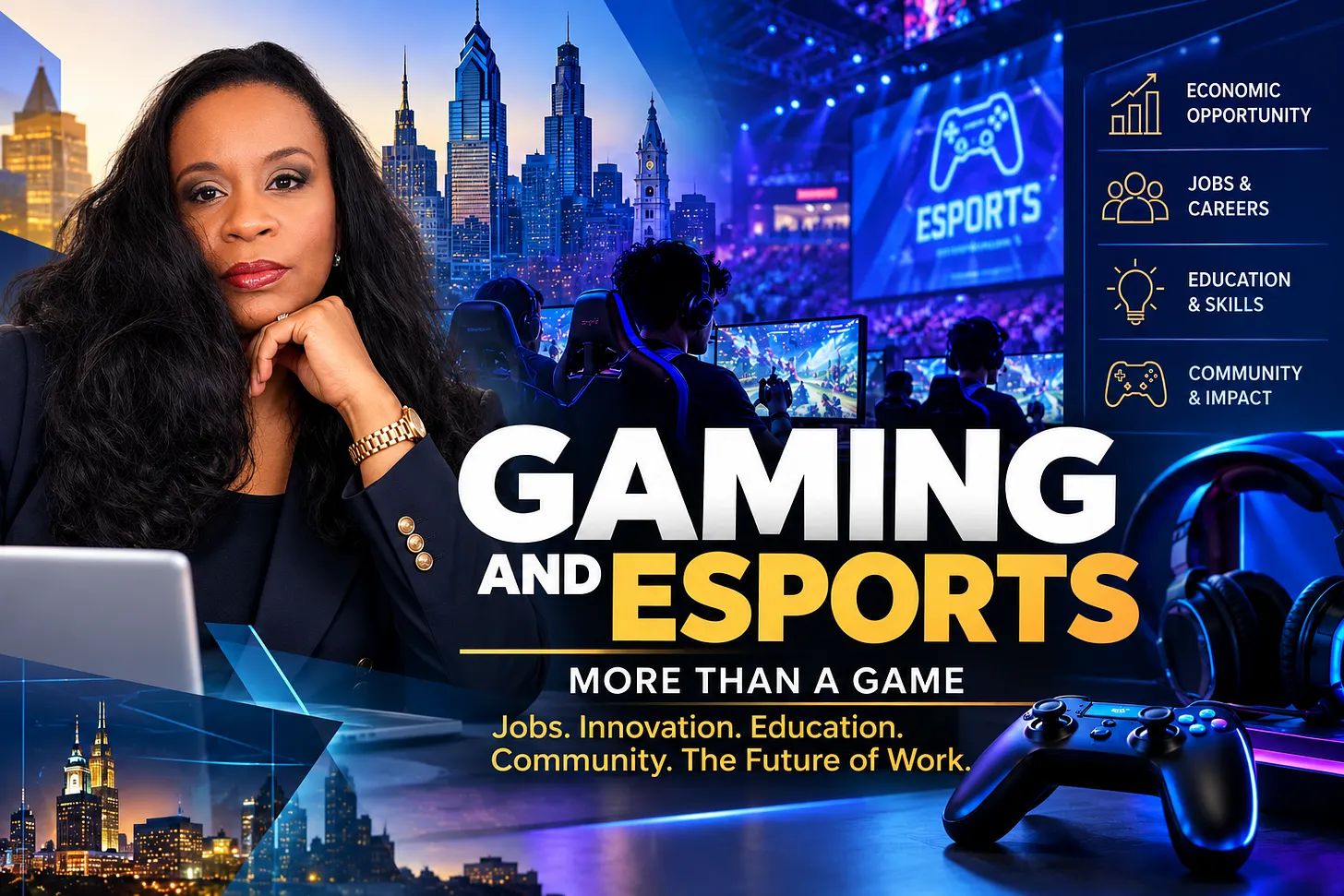
BEYOND THE LEADERBOARD
Future of Work Special Edition – Gaming and Esports
AUTHOR’S NOTE
The Contradiction. The Opportunity.
Gaming is one of the first industries people point to when they talk about tomorrow’s careers. It previews what’s coming for the rest of us: a creative, technical industry where more than a third of surveyed professionals already use generative AI. What happens to its workers tells us a great deal about our own.
This week I looked at what the gaming employment data says. It is more sobering than the marketing demonstrates. The U.S. video-game industry employed more than 21,100 fewer workers in 2025 than it did in 2023, and one in three U.S. game professionals surveyed this year reported being laid off in the past two years. But contraction is only half the story. Demand for the technical skills the industry runs on is projected to grow, and here in Philadelphia, universities are still building the talent pipeline.
A word on esports. The figures here measure the video-game industry that esports is built on. They don’t count competitors, coaches, streamers, or tournament staff, and no one has a verified count of those jobs. When the arena lights are that bright, it is worth noticing how little we can measure about who earns a living under them.
See it for yourself tomorrow. If you are in the region, stop by PHL Gaming on Saturday, October 24, from 10 a.m. to 4 p.m. at CYTOPHL, 2929 Arch Street, the closing day of 1Philadelphia’s Innovation Weekend. It brings gamers, developers, creators, educators, students, and industry leaders together with game studios, technology companies, universities, and community organizations for panels, game showcases, networking, tournaments, and hands-on experiences. Whether you are interested in game development, esports, digital design, or a career in technology, this is a chance to see, in one room, what this issue argues for: industry, education, government, and community working together so the sector can grow here. Registration is required.
FEATURE STORY
The Industry Behind the Arena Is Shrinking
Start with workforce size because the headline number misleads. You will often see that gaming “supports” about 250,000 U.S. jobs. That figure, 250,838 in the Entertainment Software Association’s 2026 economic-impact study, is an economic-impact estimate. It adds supplier jobs and jobs supported by workers’ spending to the direct total. The industry directly employs 82,930 people, and 63,248 of them work in game software: studios, publishers, platforms, and tool makers.[1]
Now, the direction. Comparing 2023 and 2025, the study found more than 21,100 fewer U.S. industry workers, including about 12,000 fewer in software and 7,000 fewer in game retail. These are net changes, not a tally of layoff announcements, and the report cautions that changes in data coverage affect comparisons. Even so, the decline is substantial.[1]

The workers tell the same story. In the Game Developers Conference’s 2026 State of the Game Industry survey of more than 2,300 professionals, 33% of U.S. respondents said they had been laid off in the previous two years, against 28% worldwide. Half said their current or most recent employer laid off staff in the past year. The pain was concentrated at the top: about two-thirds of respondents at major, high-budget “AAA” studios reported layoffs at their companies, compared with about one-third at independent studios.[2]
Is AI the cause? A sharper headline would call those 21,100 positions “AI replacements,” but neither study counts AI-driven job losses. The ESA study points to mergers and acquisitions, workforce adjustments, and changing work arrangements. GDC does document AI arriving alongside layoffs: 36% of respondents use generative AI at work, most often for research, code assistance, routine tasks, and prototyping.[1][2]
The closed door. The group I worry about most is the one not yet on the payroll. In GDC’s smaller student survey, 74% said they were concerned about their job prospects. They pointed to too few entry-level positions, competition from experienced workers who had been laid off, and fear of AI displacement. That is a pipeline problem, and pipeline problems compound.[2]

The other side of the scoreboard. The contraction is real, but it is not the whole picture. The skills the industry runs on travel: the Bureau of Labor Statistics projects 10% employment growth for software developers, quality-assurance analysts, and testers from 2025 to 2035, with about 106,100 openings a year across all industries.[3] The audience is real too. When Philadelphia hosted the 2019 Overwatch League Grand Finals, the Wells Fargo Center sold out a month in advance, with nearly 12,000 tickets sold.[5]
What Philadelphia teaches. This city has lived both sides of the story. In 2019, Comcast Spectacor announced Fusion Arena, a $50 million, 3,500-seat esports venue at the South Philadelphia Sports Complex.[5] The pandemic paused construction; Comcast later confirmed it would not build the arena, and at the end of 2022 the city’s Overwatch League team, the Philadelphia Fusion, relocated to Seoul.[6]
What lasted was the training pipeline. Drexel University’s game design program ranks 12th for undergraduates and 10th for graduate students in the Princeton Review’s 2026 rankings, first in the Mid-Atlantic on both lists.[7] At Saint Joseph’s University, esports is a club sport in the Eastern College Athletic Conference, open to all students and backed by scholarships, with a 24-station lab in Merion Hall and, since its 2020 launch, coursework in esports marketing and interactive 3D game development.[8][9]
What comes next is being built in public. PHL Gaming, led by Councilmember Isaiah Thomas and the PHL Gaming Task Force, has grown from just over 100 people at its 2023 start to the closing day of Innovation Weekend, built around careers in game development, esports, and digital design.[10][11][12] It aims to make Philadelphia a place where gaming talent can find work, not just training.
The arena was never built. The training programs were. Buildings and franchises follow markets, but skills stay with people.
Two futures. The evidence supports two plausible scenarios, but it doesn’t yet tell us which will win. In the expansion scenario, cheaper prototyping lets teams attempt more projects, and more projects mean more work. In the compression scenario, companies take the same productivity gain and ship their existing slate with fewer people. Right now we can see AI-assisted prototyping and a significant employment contraction side by side. Leaders, not the software, will decide which one defines the next decade.[1][2]
The Gadsden Leadership Lens™
What Happened
The U.S. industry shrank by more than 21,100 workers in two years, while more than a third of its professionals adopted generative AI.[1][2]
Why Does It Matter
Gaming is a test case for every knowledge industry because AI is changing tasks there before it eliminates whole occupations. Each worker is increasingly asked: what judgment and responsibility do you bring beyond producing a first draft?
Federal projections show how uneven the answer will be. While software and testing roles are projected to grow, BLS projects little or no growth for special-effects artists and animators, about 4,200 openings a year, and says explicitly that AI may dampen demand by speeding up some tasks.[3][4]
No occupation is guaranteed protection. The useful distinction is between a job with tasks that can be accelerated and a job that can be removed.
Who Is Affected
• Students and early-career workers. 74% of surveyed students are concerned about their prospects, and they are competing with laid-off veterans for too few entry-level roles.[2]
• Designers and writers. AI use does not establish that these roles will disappear, but 63% of design and narrative respondents view generative AI negatively. Leaders should hear that as a trust problem.[2]
• Regional talent. Pennsylvania has more than 1,000 direct video-game jobs statewide. There is no verified Philadelphia-only figure. The region has strong training programs at Drexel and Saint Joseph’s; the open question, after Fusion Arena, is whether local employers will hire their graduates.[1][6][7]
What Should Leaders Do Now
• Separate the headline from the headcount. “Supports 250,000 jobs” and “employs 82,930 people” are both true and mean different things. Ask which one you are being shown before you build a workforce program around it.
• Do not blame AI for what you cannot measure. If your own reductions stem from consolidation, costs, or strategy, say so. Mislabeling the cause teaches your people the wrong lesson about where the risk is.
• Protect the entry-level door. When you automate routine work, you take the first rung of the ladder with it. Preserving routes into the profession is a design decision, and it needs an owner.
• Redefine roles around judgment. Write job descriptions for work AI can’t complete. Requirements, system integration, risk evaluation, and taking ownership of the result.
• Invest in skills that travel. Gaming’s losses sit alongside projected growth in broader software work, favoring skills that transfer between gaming and other software or interactive-media fields.
What’s Coming Next
Watch worker power: 82% of U.S. respondents to the GDC survey support unionization of the industry. That signals strong interest in collective influence over working conditions, though it doesn’t prove specific protections will follow.[2]
Healthcare Innovation Spotlight™
Gaming and healthcare look like opposites, but their workforce questions are the same. This is my leadership read across the two, not a finding from the gaming data.
Tasks first, jobs later. Health systems are bringing AI into documentation, scheduling, and analytics in the same way studios brought it into prototyping and code assistance: by accelerating the first draft. CNIOs and healthcare IT directors should define, role by role, where human judgment and accountability sit after the draft is produced.
Design the apprenticeship on purpose. Game students are reporting too few entry-level positions. Healthcare has its own version of that risk. If AI absorbs the routine build requests, report writing, and first-pass work that new analysts and new informaticists used to learn on, experience will not accumulate by accident. Someone has to design how the next generation gets it.
Look at the talent leaving the studios. Simulation, interface design, usability testing, and quality assurance are game-industry skills health systems need for clinical training and patient-facing digital tools.
Leadership Takeaways™

Looking Ahead
This issue keeps returning to a closed door: too few entry-level roles. Apprenticeship is the oldest answer to that problem. An apprentice is paid while learning, training is tied to a real job, and hiring shifts from a candidate’s credential to the skills they can demonstrate.
Pennsylvania is a useful place to watch. Under Governor Josh Shapiro, the Commonwealth has made apprenticeship a centerpiece of its workforce strategy:

These examples come mostly from the skilled trades. The open question for the future of work is whether the same model can reach digital and creative fields like the one in this issue, where AI is absorbing the routine tasks beginners used to learn on.
In an upcoming issue, I will look at what it would take to build apprenticeships for the jobs AI is changing fastest. Gaming shows what happens when the first rung of the ladder disappears. Apprenticeships are one way to rebuild it on purpose. Events like PHL Gaming bring local talent and local opportunity together, and I will be watching whether they turn into hiring.
Eileen B. Gadsden, MBA is a U.S. Army Veteran and Past President of BDPA Philadelphia. She is the Fractional CFO; Ai & FinTech Strategic Advisor; and Founder of E-Region Enterprises
SOURCES
[1] Entertainment Software Association and TEConomy Partners, 2026 Economic Impact Report (full study). https://www.theesa.com/wp-content/uploads/2026/04/EIR_2026_FINAL.pdf
[2] Game Developers Conference, 2026 State of the Game Industry. https://gdconf.com/article/gdc-2026-state-of-the-game-industry-reveals-impact-of-layoffs-generative-ai-and-more/
[3] U.S. Bureau of Labor Statistics, Occupational Outlook Handbook: Software Developers, Quality Assurance Analysts, and Testers. https://www.bls.gov/ooh/computer-and-information-technology/software-developers.htm
[4] U.S. Bureau of Labor Statistics, Occupational Outlook Handbook: Special Effects Artists and Animators. https://www.bls.gov/ooh/arts-and-design/multimedia-artists-and-animators.htm
[5] Saint Joseph’s University, “5 Key Facts About Esports” (2020). https://www.sju.edu/news/5-key-facts-about-esports
[6] Technical.ly, “Philly lost its Overwatch team to Seoul” (January 2023). https://technical.ly/startups/philly-lost-overwatch-team-fusion-seoul/
[7] The Princeton Review, Top Schools to Study Game Design for 2026. https://www.princetonreview.com/press/game-design-press-release-2026
[8] Saint Joseph’s University, Esports program page. https://www.sju.edu/esports
[9] Saint Joseph’s University, Campus Recreation: Club Sports. https://www.sju.edu/athletics/campus-recreation/club-sports
[10] PHILADELPHIA.Today, “Innovation Weekend 2026: Philadelphia’s Startup Event Returns Oct. 21–24” (October 2026). https://philadelphia.today/2026/10/innovation-weekend-2026-philadelphia-startup-event/
[11] PHL Gaming event registration page (Luma). https://luma.com/iw26_gaming
[12] The Philadelphia Inquirer, PHL Gaming festival coverage (August 2024). https://inquirer.com/news/philadelphia/phl-gaming-festival-isaiah-thomas-20240807.html
[13] Pennsylvania Department of Labor & Industry, “Shapiro Administration Highlights Record $193 Million Investment” (July 2026). https://www.pa.gov/agencies/dli/newsroom/shapiro-administration-highlights-record–193-million-investment
[14] Office of the Governor, “Gov. Shapiro Announces $3 Million Investment to Steamfitters Apprenticeship” (February 2026). https://www.pa.gov/governor/newsroom/2026-press-releases/gov-shapiro-announces–3-million-investment-to-steamfitters-appr
Survey figures describe respondents, not the entire workforce. Employment figures are industry estimates, not a government
A N N O U N C E M E N T

Leave a Reply