

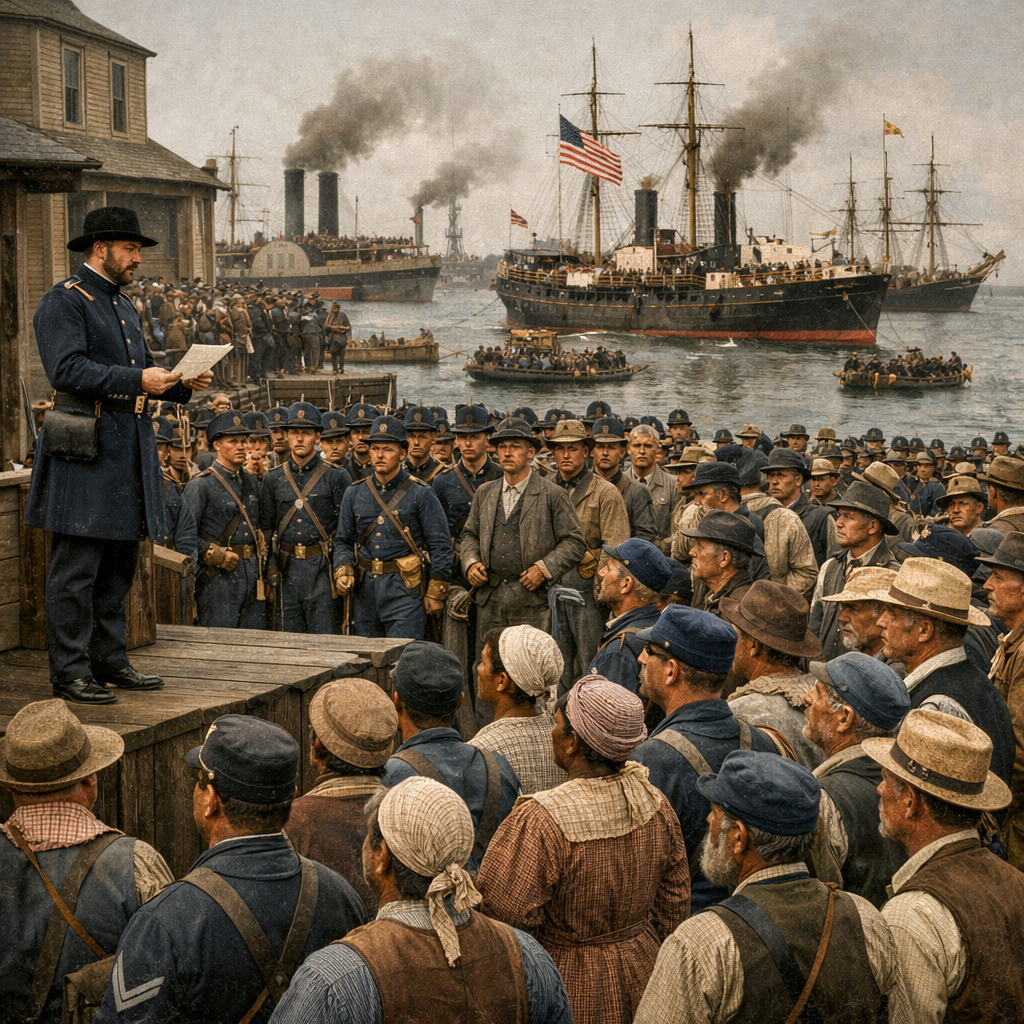
Juneteenth is remembered as the day freedom finally reached Texas. This story highlights people who already knew of a ‘Freedom Day’ by way of the “Grapevine Telegraph”, a secretive, word-of-mouth communication system used primarily by enslaved African Americans and Union forces to pass vital military intelligence, troop movements, and news throughout the South. In the roughly thirty months between the Emancipation Proclamation being signed on January 1st, 1863 and June 19th 1865, broken telegraph lines and deliberate delays in enforcement allowed land owners and planters to wring out extra “ghost harvests” of cotton and sugar, while financiers used information gaps to move these fortunes before abolition finally arrived. Freedom was withheld. Harvests were stolen. “Black Data” , The Indian Territory (present-day Oklahoma), and U.S. Census data was evolving . . .
LARGO, Maryland (bdpatoday®) — The datafication of Black life in nineteenth-century America produced fragmented records that captured individuals as property while erasing them as persons.[1] The result was a lasting legacy of archived “Black Data,” a record defined by erasure and miscounting that stands in sharp contrast to the June 19th liberation now celebrated as Juneteenth.

When we picture the American institution of slavery, we often imagine rural Southern plantations physically cut off from the rest of the world. But American slavery was never just a Southern enterprise. It was the bedrock of a global financial system, deeply integrated into Northern banks, British textile mills, and the trading floors of Wall Street.[2, 3] It was on those floors that fortunes were made by speculators who traded cotton futures, even as the futures of enslaved people who grew cotton were stolen outright.[4] In June of 1865, as the nation struggled to claw itself back together, defining battlegrounds were no longer fought with muskets and bullets, but with new infrastructure and technology requirements whose grip on Black life would outlast Juneteenth itself.
Wall Street’s Invisible Chains
The financial infrastructure of New York and Boston didn’t just passively benefit from the slave economy; it aggressively funded and sustained it. Southern enslavers relied heavily on Northern credit to purchase more land and buy more enslaved people [2]. Wall Street tycoons like Charles P. Leverich (Vice President of the Bank of New York) and Moses Taylor (President of City Bank of New York) functioned as financial mechanics for human bondage, laundering the massive profits from slave-gowned crops into respectable Northern corporate stocks, real estate, and industrial infrastructure [2]. For wealthy individuals and massive commercial transactions, funds crossed lines internationally. Both Wall Street tycoons and Confederate agents used British banks as clearinghouses. While official mail between the North and South was halted during the Civil War, courier networks physically carried gold, cash, and private banknotes across state lines hidden in wagons or maritime vessels.
Through complex financial innovations, humans were commodified into securities. Enslaved people were used as collateral for mortgages, and those mortgages were bundled together and sold to investors, including international ones, as a dark precursor to modern securitized debt [3]. Between 1851 and 1860 alone, enslaved Black people produced over $1.5 billion in cotton (equivalent to tens of billions today) [2]. This wealth didn’t burn away in the Civil War; it was woven directly into the foundational institutions of American capitalism that survive today [2, 3].
The Texas Safe Haven and Refugee Slavery
As the Civil War progressed, Texas transformed into a literal and financial stronghold for the collapsing Confederacy. As Union armies marched through Alabama, Mississippi, and Louisiana, freeing enslaved laborers along the way, Southern landowners took desperate measures to preserve their human collateral. In a massive, coordinated migration known as “refugee slavery,” enslavers forcibly moved an estimated 150,000 or more enslaved people west into Texas [4, 5].Texas was viewed as a safe haven because it was geographically isolated from the primary theaters of war. By transferring their human property across the Mississippi River, planters effectively kept them out of reach of liberating Union forces, creating an artificial bubble where the slave economy could continue to churn entirely uninterrupted [4].
The Battle of the Wires: 1865 Communication Technology
The roughly 30-month gap between Abraham Lincoln’s Emancipation Proclamation taking effect on January 1, 1863, and the arrival of freedom in Galveston on June 19, 1865, was a product of severe administrative, operational, and technological fragmentation [4].
By June 1865, the communication infrastructure of the American landscape was fractured into three distinct realities:
- The Union States: Controlled the highly centralized, heavily funded U.S. Military Telegraph Corps. With thousands of miles of newly strung wire and field operators using Morse code tap-keys, Washington could communicate with frontline commanders east of the Mississippi almost instantly [4].
- The Confederate States (Trans-Mississippi): The South’s commercial telegraph lines were in complete ruin. Copper wire had been melted down for munitions, and poles were burned. Crucially, the fall of Vicksburg in 1863 severed the physical telegraph cables crossing the Mississippi River. Texas was effectively amputated from the rest of the American continent [4].
- The Indian Territory: Lacking formal telegraphic infrastructure, this unorganized territory relied almost entirely on equestrian couriers, military scouts, and slow-moving riverboats [6]. Information drifted into the territory via the physical movement of people, lagging weeks behind the East Coast.

The “Grapevine Telegraph” and Spy Networks
Where formal technology failed, human intelligence filled the void. Long before major military commands reached the deep West, alternative networks carried the true status of the war.
The most potent of these was the “Grapevine Telegraph,” an underground oral communication network maintained by enslaved populations. The term and the practice are documented in Booker T. Washington’s autobiography Up From Slavery, in which he recalled that enslaved people often learned the results of major battles before the white households around them, with news relayed from the post office and passed quietly from plantation to plantation [10]. Through coded spirituals sung in fields, whispers across plantations, and night riders traveling on foot, enslaved people tracked the advance of Union troops with remarkable accuracy.
Market Manipulation and the Cost of Silence
This profound information asymmetry also provided a smokescreen for calculated greed. Many Southern landowners were aware of the Emancipation Proclamation and of the subsequent collapse of Richmond in April 1865. Most notably, news of the Proclamation had reached Texas and even appeared in Texas newspapers well before 1865; the central obstacle to freedom was the absence of Union troops to enforce it [9]. Where they could, planters weaponized local control over their broken telegraph lines to intercept news and silence anyone who tried to spread word of the executive order [4].
This orchestrated information environment served as a massive financial windfall that reverberated all the way to New York. By maintaining silence and control, Texas planters successfully squeezed out additional, uninterrupted harvest seasons [4]. Cotton, sugar, and rice continued to flow via forced labor.
For Northern financiers and commodity brokers, this information lag was highly lucrative:
- Speculation and Arbitrage: Insiders on Wall Street and in the Liverpool textile mills who caught early wind of the Confederacy’s complete collapse via maritime spy networks or early military wires could short-sell cotton futures or dump depreciating Confederate bonds before the general public realized the slave economy had legally ended [4].
- Capital Realignment: The delay insulated Wall Street portfolios from the immediate shock of absolute abolition. It allowed the financial elite to quietly transition their capital out of Southern agricultural debt and into modern Northern industrial corporations, railroads, and the gold market before the hammer of freedom finally fell [4].
Juneteenth: The Interrupted Harvest
Freedom finally arrived in Texas on June 19, 1865, when Union General Gordon Granger arrived in Galveston backed by more than 2,000 federal troops. With the physical presence of federal bayonets behind it, General Order No. 3 declared: “The people of Texas are informed that, in accordance with a proclamation from the Executive of the United States, all slaves are free.” [9]

Juneteenth marks the official breaking of those financial chains, but it also underscores a sobering truth. The months stolen between the proclamation and its enforcement demonstrate how deeply American economic systems prioritized investor profits over human rights. While Wall Street pocketed the windfalls of those final harvest seasons, the newly freed people were left with nothing but the clothes on their backs [4].
The Indian Territory Footnote
The 1863 Emancipation Proclamation only applied to states in rebellion and did not legally affect slavery in Native American areas that fought for or signed treaties with the Confederate States of America [6, 7]. For most enslaved people in Indian Territory (modern-day Oklahoma), actual freedom came long after Juneteenth [6, 7].
Prior to Juneteenth, the Cherokee National Council repudiated its Confederate treaty and, in February of 1863, voluntarily abolished slavery as a matter of tribal law [5]. However, because there were no telegraphs or federal troops to enforce it, many isolated slaveholders in the territory ignored the decree [6].
It was not until the Reconstruction Treaties of 1866 that the United States government forced all of the “Five Civilized Tribes” to officially abolish slavery [6]. The Creek (Muscogee), Seminole, Choctaw, and Chickasaw Nations did not emancipate during the war at all [6]. In Indian Territory, enslaved Black people of these nations spent roughly another full year in servitude well after Juneteenth, waiting for slow-moving treaties to catch up to the reality of their freedom [6, 7].
U.S. Census Slave Schedules
In 1860, enslaved people were not documented by name in the federal census. Instead, the government printed two completely separate forms: Schedule 1 (Free Inhabitants) and Schedule 2 (Slave Inhabitants), and the slave schedules recorded only the enslaver’s name alongside each enslaved person’s age, sex, and “color” rather than any personal names [8]. Because thousands of Black people were enslaved by wealthy Native American landowners, the federal government still sent enumerators to protect federal tax and political apportionment data. White, Black, and “mulatto” residents of the Indian Lands who were not Native Americans were enumerated as part of Arkansas, and those records were appended to the very end of the Arkansas census microfilm rolls, immediately following Yell County, under the heading “Indian Lands” [8]. As in Texas, enslaved Black people were listed anonymously under the names of their Native planters or enslavers by age, sex, and color [8]. “Freedom” arrived in 1865 with nothing attached: no land, no capital, and former enslavers who still controlled the economy. Cotton still needed picking and landowners still needed workers.

By 1870, the ratification of the 13th Amendment had abolished slavery, completely eliminating Schedule 2. For the first time, formerly enslaved people were to be counted by their full names as citizens on the main population schedule. In Texas, because many newly freed people took new surnames, moved across counties to locate missing family members, or migrated into urban centers, federal enumerators heavily undercounted Black Texans.
In what is now modern-day Oklahoma, the U.S. Census Bureau did not officially enumerate the general population of the Indian Territory in 1870 or 1880 [7]. For most of the nineteenth century, the Constitution mandated counting only “taxed” individuals. Citizens of the Five Civilized Tribes, including newly emancipated Black “Freedmen” who had been adopted into the tribes via the Reconstruction Treaties of 1866, were considered members of sovereign nations, and were therefore treated as “Indians not taxed” and excluded from these federal counts [8].
Portions of this special Juneteenth article were generated with assistance from Ai tools based on prompts developed by bdpatoday® and the author. All content has been reviewed, verified, and edited by the author, who is responsible for this final version.
Footnotes
- [1] Jessica Marie Johnson, “Markup Bodies: Black [Life] Studies and Slavery [Death] Studies at the Digital Crossroads,” Social Text 36, no. 4 (137) (December 2018): 57–79. https://doi.org/10.1215/01642472-7145658
- [2] Time Magazine, “How Wall Street Funded Slavery.” https://time.com/6692434/wall-street-slavery-essay/
- [3] The New York Times Magazine, The 1619 Project, Matthew Desmond, “Slavery and Capitalism” (also published as “American Capitalism Is Brutal. You Can Trace That to the Plantation”). https://www.nytimes.com/interactive/2019/08/14/magazine/slavery-capitalism.html
- [4] Alex Trias, “Financial Lessons from the Civil War,” Substack. https://alextrias.substack.com/p/financial-lessons-from-the-civil
- [5] History.com (A&E Television Networks), “Juneteenth: Why It Took 2.5 Years for Freedom to Reach Texas,” which sources the 150,000 refugee-slavery figure to The War of the Rebellion: A Compilation of the Official Records of the Union and Confederate Armies. https://www.history.com/articles/juneteenth-emancipation-proclamation-texas — For the contested range (roughly 50,000 to 150,000) and the origin of the high estimate with Confederate General John B. Magruder, see W. Caleb McDaniel (Rice University), “How Many Slaves Were Refugeed to Confederate Texas?” http://wcaleb.rice.edu/blog/how-many-refugeed-slaves-in-texas
- [6] Oklahoma Historical Society, The Encyclopedia of Oklahoma History and Culture, “Freedmen” / Emancipation in Indian Territory. https://www.okhistory.org/publications/enc/entry.php?entry=FR016
- [7] Time Magazine, “When Did Slavery Actually End in America?” https://time.com/6286476/juneteenth-when-did-slavery-end/
- [8] U.S. National Archives, “1860 Census Records,” which documents Schedule 2 (Slave Inhabitants) and states that non-Native “white, black, and mulatto” persons on the Indian Lands (Creek, Cherokee, Chickasaw, Choctaw, and Seminole) were enumerated as part of Arkansas. https://www.archives.gov/research/census/1860 — For the microfilm arrangement (Publication M653, Roll 52: “Washington, White, and Yell Counties; and Indian Lands”), see the National Archives 1860 Federal Population Census Microfilm Catalog. https://www.archives.gov/research/census/microfilm-catalog/1790-1890/part-04 — For the slave-schedule format (enslaved people enumerated without names under the enslaver), see FamilySearch, “United States Census Slave Schedules.” https://www.familysearch.org/en/wiki/United_States_Census_Slave_Schedules
- [9] U.S. National Archives, “General Order No. 3” (the original 1865 manuscript signed by Maj. F.W. Emery on behalf of Maj. Gen. Gordon Granger), National Archives News. https://www.archives.gov/news/articles/juneteenth-original-document
- [10] Booker T. Washington, Up From Slavery: An Autobiography (1901), Chapter 1, “A Slave Among Slaves,” describing the “grape-vine telegraph” by which enslaved people learned war news. Full text via Project Gutenberg. https://www.gutenberg.org/files/2376/2376-h/2376-h.htm
- [11] Central Intelligence Agency (CIA), “Honoring Harriet Tubman: A Symbol of Freedom and an Intelligence Pioneer,” on Tubman’s recruitment of formerly enslaved scouts and her Civil War intelligence work. https://www.cia.gov/stories/story/honoring-pioneer-harriet-tubman/ — On Mary Bowser and the broader network of Black Union agents, see Brandeis University, “Harriet Tubman: Civil War spy?” https://www.brandeis.edu/now/2022/june/tubman-civil-war-larson.html
A D V E R T I S E M E N T

Leave a Reply